I am an art historian, painter and poet living in East Sussex. I used to write and lecture about photography and video art but turned my fuller attention to poetry about ten years ago.
I completed the MA Writing Poetry with the Poetry School London and Newcastle University with a distinction in 2022. Over the years my poems have been placed in a number of competitions and I was recently lucky to win the Mslexia Pamphlet Prize. My first pamphlet, The Man Whose Brain Turned to Glass, will be published by Bloodaxe Books in September.
Pamphlet
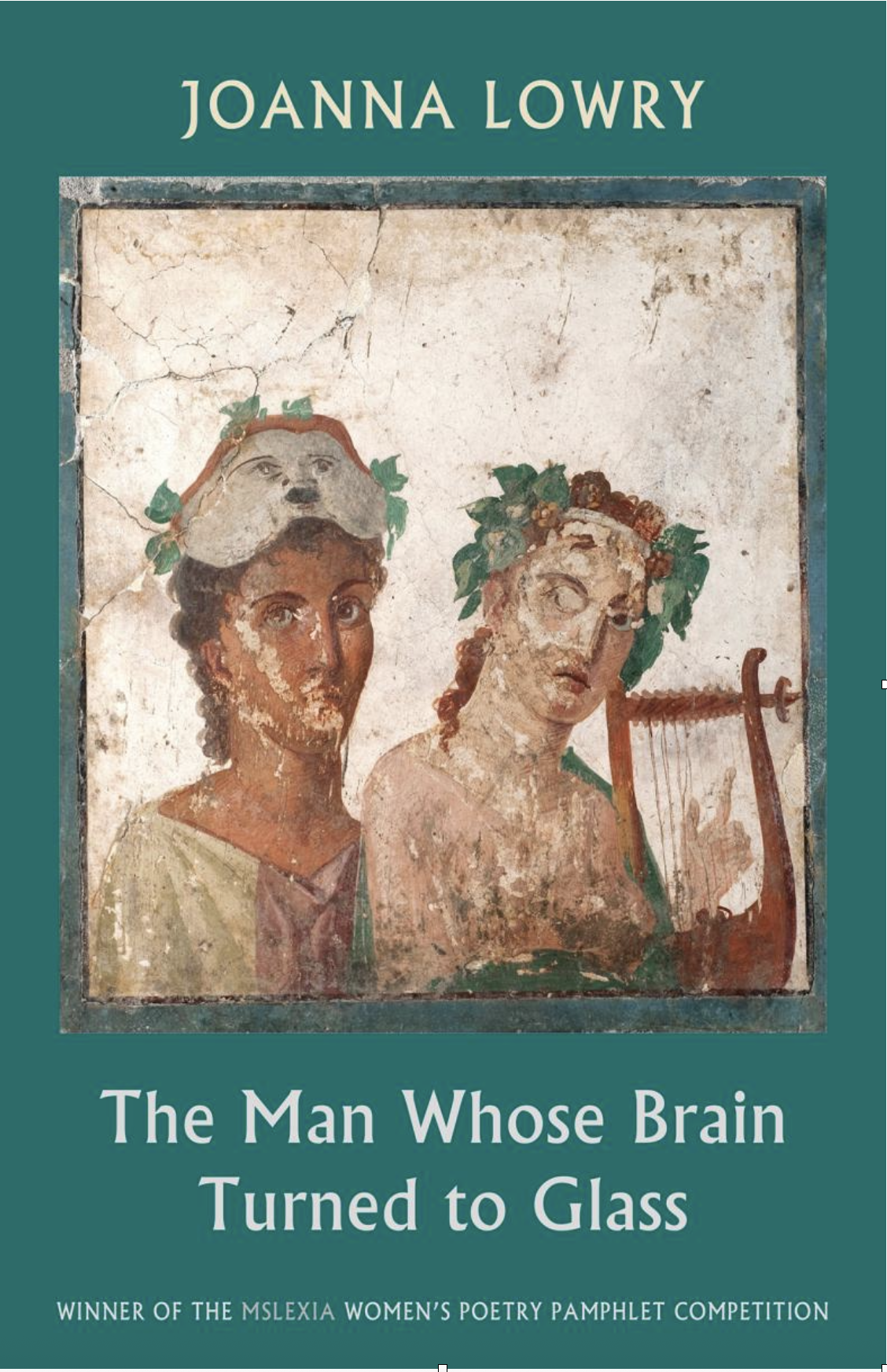
The Man Whose Brain Turned To Glass
A long sequence of recurring wars and natural disasters forms a backdrop to these poems which trace the ways in which we attempt to weave our way between these forces of catastrophe through retrieving tiny moments of beauty and contemplation: a few words written on a scrap of paper in a dead poet's pocket, a clay model of a buddha on a desert floor, a miniature portrait, a cave painting, a shiny fragment of black twisted glass.
Each of these objects represents an encounter with a lived moment that is precious, and that is at the centre of a story which is deeply felt and human, the kind of story that sits outside the larger tide of history, one that helps us to believe we might be saved by art…
'In poem after poem, Lowry works her images and references with great confidence and clarity, sometimes quietly mysterious, sometimes sparkling, varied but deeply connected. She works with the dedication and formal skill of a miniaturist. It is an engagement of the body as well as the mind that links the object, the poet and the wider environment in a finely articulated series of relationships.'
— Imtiaz Dharkar
'Joanna Lowry's poetry voyages through time and space with the pale demeanour of a ghost, now perplexed, now disabused, never able to look away. It haunts the galleries of history getting the details right, revisiting moments and figures still living out their fates, but always emerging into the forlorn light of now, as the living poet bearing the scars of it all, the aftermaths of love or horror, the deeds and delusions of men forever sounding in the dark. Lowry's is a poetry of the still point and the turning world: this is a rich and memorable collection.'
— Glyn Maxwell
'In this exceptional debut, Joanna Lowry writes of the painstaking art of the miniaturist, an apt analogy for what she is able to accomplish in her poems. She traces the steps of artists such as Lee Miller and Antonio Machado, chronicles the final hours of Herculaneum, arrives in the museum or at the edge of a cliff. Her painterly eye takes in places as vast and varied as St Petersburg and the Gobi Desert; in these landscapes are stains of human intervention, shadows obscuring the light, but Lowry is always impeccably accurate in showing us what it is to be present and observant — a witness to life.'
— Tamar Yoseloff
'The Man Whose Brain Turned to Glass is a fine project of transformative imagining, a compendium of lyric explorations of moments in global and individual history brought together into an extraordinary and moving poetic whole.'
Manchester Poets and Players Competition
Commended
2012
Bridport Prize
Shortlisted
2010
Arvon International Poetry Prize
Shortlisted
Poems
Seal
Seeking the freedom of sleep I conjured myself as a seal,
sleek and swollen, edging clumsily towards the rim
of a frozen ice floe, then slipping down
into the ocean, rolling and diving, instantly free.
I pictured the way it moved, released from all constraint,
and deep in its belly coiled intestines, bundles
of transparent lace floating in their own black sea.
Tired from lack of sleep I saw a seal's intestines once
–– in a museum. I stepped out of a dark corridor.
It was flash-lit: that luminous cloak sewn from seal gut,
stretched, brittle and tissue-paper thin,
and though torn from deep inside the seal's body,
proof against all weather, magically protecting
its owner from the arctic wind.
Last night my dead husband appeared on a dais
in a beam of light. Sliding those slim tweezers
down his throat he pulled out a shimmering strand of gut.
It pooled in coils at his feet. He seemed at that moment
to be pharaonic, at the mouth of a shining delta,
or at the centre of a pattern of wavelets on hard black water —
where a seal had just plunged out of sight.
(Second Prize, Edward Cawston Thomas Competition)
The City of Doubles
Slipping into that place, as through a mirror,
I was confronted with my other: shadowed,
dark-dealing, her gloved hands mimicking mine.
In this world of doubles no-one was alone: twinned
selves strolled the streets, voices in unison,
then peeling apart, singing different songs.
I saw my mother twice, standing at a door: one face
full of love, the other hard and cold. I embraced her,
kissed her two cheeks. One of my hearts froze.
My father was silhouetted behind her in a corner
of the room. A black creature crouched at his feet,
in the gathering gloom. My husband kissed me.
His fingers grazed my collar-bone. Startled,
I imagined for a moment he was the other one.
I span around, glimpsed the choreography
of their uncanny twinned life. Which one did I love?
I stared at him. They both stared back, identical,
but strangely reversed in the mirrored light.
(Published in A Palace of Verandas, ed. Peter Pegnall, Traça Edições 2024)
Golden Lily Feet
The photograph shows a young Chinese
Woman, perhaps a hundred years ago.
I know because the print is small and silvery
And it has the quality of fine sand, and because
She is dressed in beautiful brocade robes
And because her feet are bound.
Her face holds my gaze like a vice,
So perfect, like an oval moon, with only
The faint calligraphy of fine eyebrows
And the traced contour down the bridge of the nose
To her small mouth, and her glass eyes that look
Fiercely down the years into mine.
It might be porcelain, her skin, and she herself
A vase, and the tapestry folds of her dress
Might be a cloth draped around a piece
Of furniture, for beneath them her
Embroidered feet peep out: small carved castors
That she might be rolled around on,
Or tiny hard buds: tightly folded flowers.
(3rd Prize, Teignmouth Poetry Competition 2018)
Luxembourg Gardens
November in the Luxembourg Gardens —
the silver air darkening in anticipation
of a long Parisian winter, and the breeze
from the Seine melancholy with cold.
We walk a white path that fans out
under the bare trees. My friend is in love,
alight with a sexual energy that only arrives
once in a lifetime. It makes me laugh.
We are encircled by statues wrapped up
for winter, draped in stiff calico,
bound tight with ropes to protect
them from the coming frost.
Reines Francaises and Femmes Illustres, she says,
posing in front of a shrouded Queen.
I take the photo because she is
radiant, and that is precious to me,
but in truth my mind is elsewhere.
It has travelled under those heavy cloths,
to a place of stillness, silence,
cold marble turned in on itself.
Figural
V is telling me about beauty. We don't always see eye to eye.
He tells me it can release any object from the world —
like a figure in a tapestry stepping out of the gloom,
haloed with soft light.
He points to the outline of the Walking Madonna in front
of the cathedral. She strides purposefully away from her own
catastrophe, rain in a blur, spine tilted
into the coming night,
and like a slow film unspooling I see Virginia walk to the Ouse:
pocketed stones, laced boots, a small figure moving out of sight.
I hate her drowning in that dull river: its grey mud,
the eternal drag of its tides.
V argues it was different then — the embankments not yet built.
He says it had a silvered beauty: a meandering floodplain;
flat sheets of water lying still, old mirrors
under the late-afternoon sky.
The Miracle of the Black Leg, Fra Angelico (1438–42)
The door to the chamber is open — even long-dead saints
come in through the door — and the room light is gentle,
grey folds of curtains around the bed even and composed.
The sleeping verger lies on two pillows, hands crossed on chest.
Cosmas and Damian, kneeling, have removed his diseased leg
and we see them slowly attach the new one. It is black.
Their hands are perfect flowers. They stroke it with tenderness:
this uncanny thing. Beautiful yet extraordinary. I gaze at that
scene of care: the light, the containment, the small slippers
waiting by the side of the bed. All solicitude, heads bowed
and haloed with concern. The love required to keep a man alive.
For a brief moment my mind strays to that other place
beyond the lit door (which even now I want to close):
a neglected cemetery, the dark coffin of the Ethiopian —
the white limb, ulcerated, weeping, lying by his shadowed side.